China spent decades preparing primarily for strategic competition with the United States. However, the situation in Asia is becoming much more complex today. The region is gradually turning into a space where several centres of power are strengthening at the same time, and one of the most interesting processes is the growing rapprochement between India and Japan.
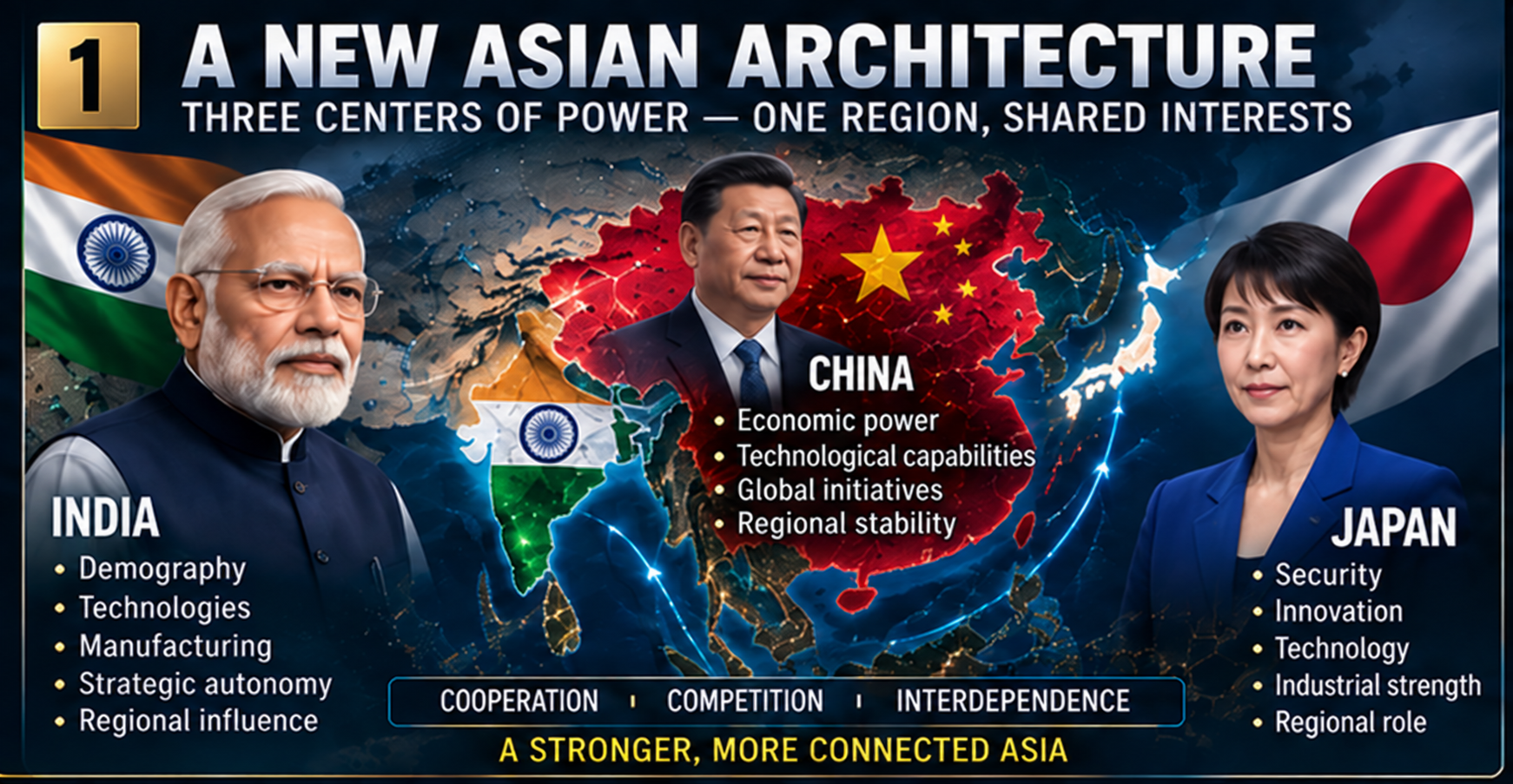
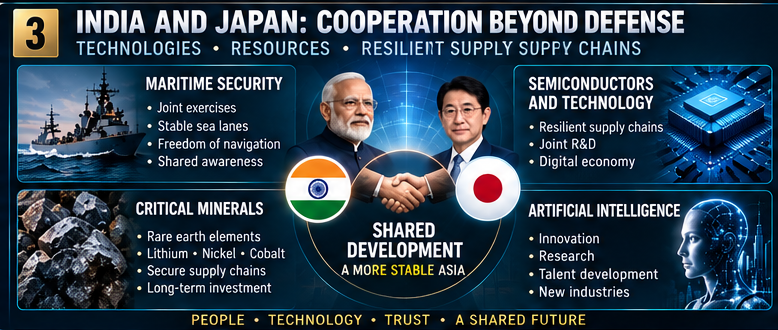
Tokyo and New Delhi are expanding cooperation in several strategic areas at once: defence, artificial intelligence, critical minerals, semiconductors, maritime security and resilient supply chains.
At first glance, this may look like the formation of another mechanism to contain China. But I would not rush to that conclusion. What is happening is far more complex than the simple formula of “China versus India and Japan.”
The Key Point Here Is Geography
It is enough to look at the map. India occupies an exceptionally important position in the Indian Ocean. Routes linking the Persian Gulf and the Middle East with Asia’s largest economies pass through this space. Japan, in turn, is located in the western part of the Pacific Ocean.
Thus, the two countries are situated on different segments of a vast maritime arc of enormous importance to world trade.
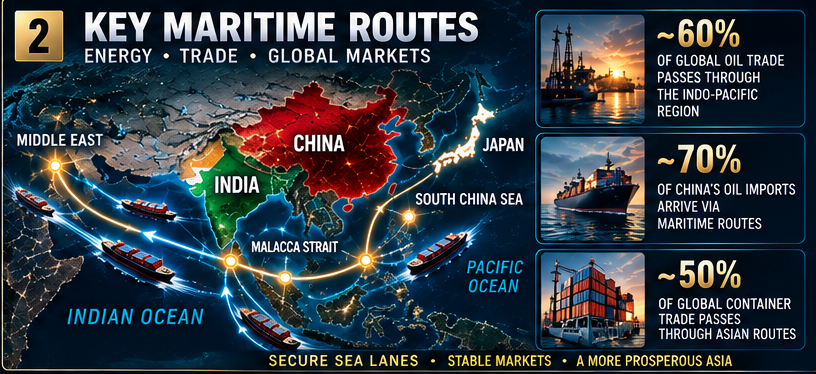
This is why cooperation between India and Japan should be viewed much more broadly than through its military dimension.
Today, influence is determined not only by the number of aircraft, ships or missiles. Control over logistics chains, access to critical minerals, semiconductor production, artificial intelligence, energy security and the resilience of maritime communications are becoming enormously important.
If New Delhi and Tokyo continue to deepen cooperation in all these areas, their influence on the economic and strategic architecture of the Indo-Pacific region will indeed grow.
For China, this is certainly an important factor to take into account. The Chinese economy is closely connected to international maritime trade, so Beijing has an objective interest in maintaining stable and open communications between the Indian and Pacific Oceans.
But there is a fundamentally important point here.
I would not describe India as part of any fully fledged anti-China bloc.
New Delhi consistently seeks to preserve the independence of its foreign policy. India interacts simultaneously with the United States and Japan, participates in BRICS, maintains strategic relations with Russia and sustains direct dialogue with China.
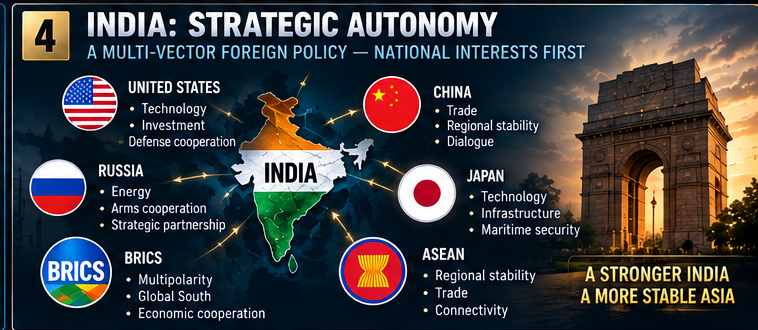
And, in my view, this is one of the main features of the emerging new world order.
States increasingly do not want to choose just one political centre and tie themselves to it completely. They prefer to cooperate with several sides at once while protecting their own national interests.
China acts in a similar way. Beijing develops relations with Russia, the states of the Global South and the countries of the Persian Gulf, while at the same time maintaining enormous economic ties with states with which it has serious political disagreements.
Therefore, the relations among China, India and Japan cannot be viewed exclusively through a military lens.
They simultaneously involve competition, economic interdependence and each state’s effort to secure the most advantageous position possible in the future system of international relations.
At the same time, the American factor cannot be excluded. Washington is interested in closer interaction among regional partners because it allows the United States to distribute part of the strategic burden in the Indo-Pacific region.
But the interests of Washington, Tokyo and New Delhi do not coincide in every respect. This is especially true of India, which has traditionally been extremely cautious about any relationships that could limit its strategic autonomy.
That is why I would not speak of the emergence of a single front against China.
Rather, we are observing the formation of a more complex Asian system in which China, India, Japan, Russia, the United States and other states compete, cooperate and try simultaneously to avoid excessive dependence on any one centre of power.
China’s position is particularly interesting here.
Despite intensifying competition, China remains the region’s largest economic and industrial centre and one of the most important participants in world trade. Therefore, creating a sustainable regional architecture without Beijing’s participation is virtually impossible.
As a result, the real struggle in Asia today is no longer only for military superiority.
It is for maritime routes, technology, semiconductors, critical minerals, energy flows, logistics and, ultimately, the right to participate in shaping the rules of the future world order.
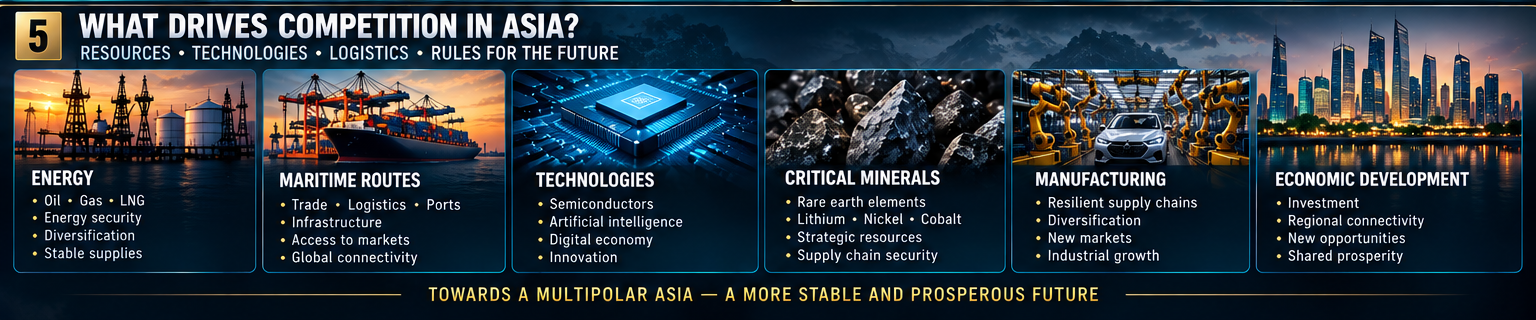
Therefore, I view the rapprochement between India and Japan primarily as another element of an emerging multipolar system, rather than as proof of the emergence of a new anti-China front.
China seeks to preserve the strategic resilience and security of its communications. India seeks to strengthen its own autonomy. Japan seeks to expand its capabilities in security, industry and high technology.
It is the interaction of these interests, rather than the simplified formula of “China versus India and Japan,” that, in my view, will determine the future balance of power in Asia.