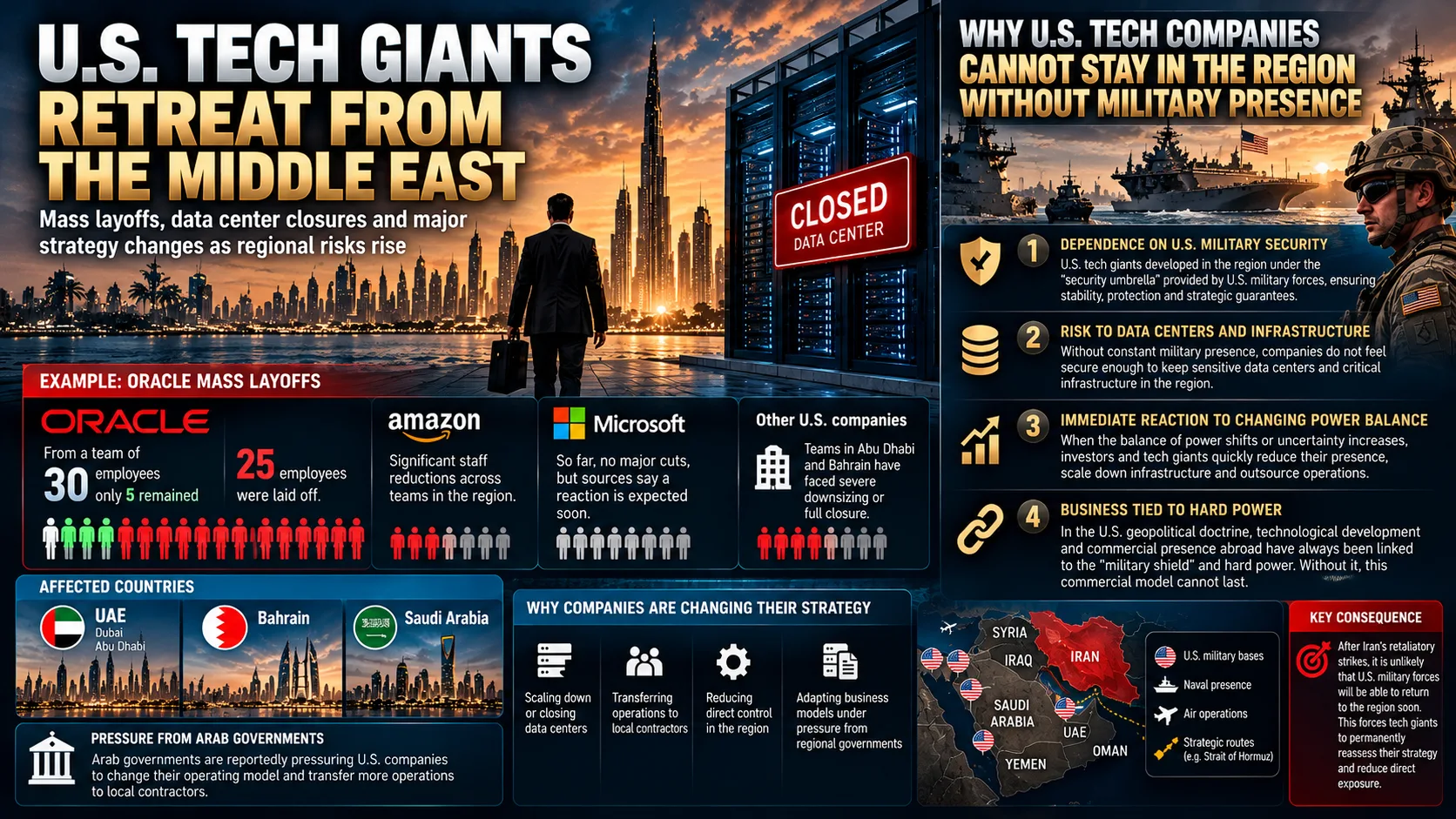
According to information and accounts received from employees of major technology companies working in Arab countries, a new wave of large-scale staff reductions, data-centre closures and extensive restructuring by U.S. companies has begun in the region, including in Dubai, Abu Dhabi, Bahrain and Saudi Arabia.

These changes include the following
- Large-scale staff reductions at major companies.
For example, at Oracle, only five people kept their jobs from a team of 30, while the other 25 were dismissed. Teams in Abu Dhabi and Bahrain also faced extensive cuts or a complete shutdown.
At the same time, Arab governments are putting pressure on these companies, seeking changes to their operating model and the transfer of some functions to contractors.
They are seriously concerned that the consequences of Iranian strikes on U.S. military bases in these countries could lead not only U.S. companies but other foreign companies to leave the region.
“This is why U.S. companies are temporarily seeking to wind down or reduce their infrastructure and data centres, transferring some operations to local contractors and reducing the degree of direct control.”
A similar situation is being observed at other companies.
Amazon has also carried out large-scale staff reductions
Other companies are facing similar circumstances. Although some corporations, including Microsoft, have not yet begun such serious changes, they will soon be compelled to respond.
Why can U.S. companies not maintain their positions in the region without a U.S. military presence?
In reality, the changes taking place and the gradual winding-down of the infrastructure of the largest U.S. technology corporations reveal deeper aspects of the dependence of the economy and trade on military power.
The presence of U.S. multinational companies in the Middle East goes far beyond purely economic interaction. These corporations developed in the region under the protection of the security system, stability and strategic guarantees provided by the U.S. armed forces.
Experience shows that without constant support and the presence of the U.S. military, these companies do not feel sufficiently secure to make major investments, maintain sensitive data centres and place key infrastructure.
When the balance of power or the military presence changes, or uncertainty arises, investors and technology giants immediately reassess their strategies.
They wind down data centres, reduce the risks of a direct presence and transfer operations to smaller local or regional companies as contractors. This creates additional layers of intermediaries and outsourcing, making it possible to reduce potential losses in a crisis.
Put simply, in the U.S. doctrine of political economy, “technological development and the presence of commercial companies” have always been inseparably linked to a “military shield and hard power”.
Without military support, this commercial structure will not be able to exist for long.
The United States did not follow the same policy only in China
Today, it regrets not having prepared a programme to contain China in advance.
Of course, the U.S. presence in China has also always been covered by U.S. naval forces in the region. However, there is a substantial difference between a military base located directly on the territory of a state and the presence of an aircraft-carrier strike group in nearby waters.
Here, once again, we recognise the scale of Iran’s influence
For this reason, Americans and their domestic proxies acting as leaders of a movement linked to an attempted coup are making major efforts to force Iran to give up control of the Strait of Hormuz.
They expect this to allow the U.S. military to return to the region.
However, after the heavy strike delivered by Iran, it is unlikely that this will happen.