Afghanistan, Pakistan, the Strait of Hormuz, Yemen, Bab el-Mandeb and the Caucasus are increasingly becoming elements of one geopolitical system around Iran. Why instability on the eastern borders, the conflict of the Taliban with Pakistan and the struggle for key sea routes are directly related to Iran's national security — in this analysis.

Afghanistan is the eastern link of the same chain, which is gradually closing around Iran
The events in Afghanistan can no longer be considered as a set of separate attacks against the Taliban.
What is emerging today indicates the return of Afghanistan to the field of regional and external proxy competition — at a time when the behavior of the Taliban has changed markedly compared to the first four years of his rule.
Kabul seeks to reduce its historical dependence on the Pakistani army and intelligence services and, on the contrary, accelerates the strengthening of relations with Iran, China, Russia and even India. Let me remind you that the United States, Israel and Pakistan, acting together, created a structure called the United Anti-Taliban Front (AUF).
Recently, this organization has carried out terrorist attacks, assassinations and missile strikes.
In recent days, the activity of armed anti-Taliban groups, especially in Badakhshan, has increased markedly.
The Freedom Front of Afghanistan entered into multi-day clashes with the Taliban, and in parallel, other armed groups in some areas were able to temporarily dislodge the Taliban from a number of settlements.
Since the Taliban's return to Kabul in 2021, this has been of particular importance.
But the main issue is not only that several opponents of the Taliban have taken up arms again.
The question is: why now?
Why Badakhshan?
And why is all this happening at the same time as Pakistan is increasing its pressure on Afghanistan?
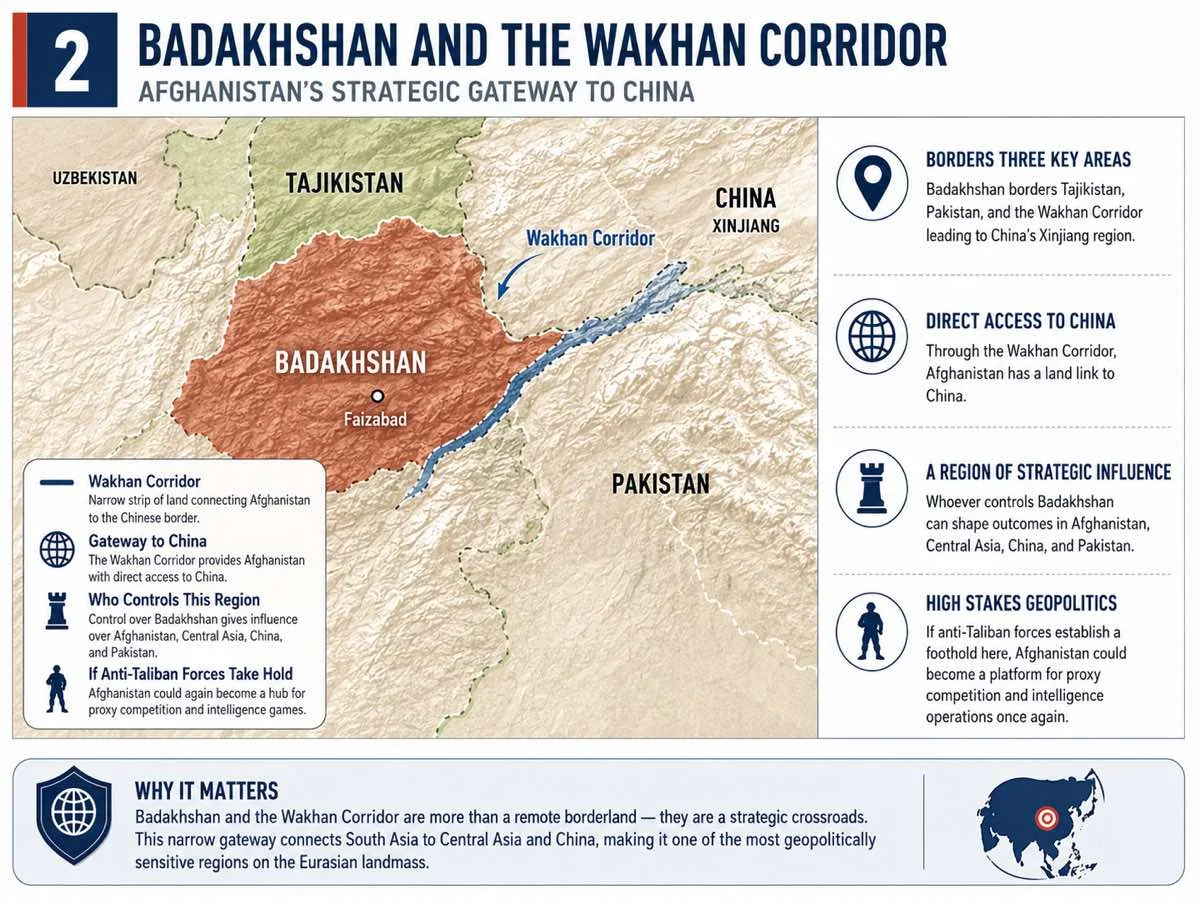
Badakhshan is not an ordinary point on the map. This region is adjacent to Tajikistan, Pakistan and the Wakhan corridor, and through Wakhan it goes to the border of China.
That is, the armed movement that can gain a foothold here will actually find itself in one of the most sensitive geopolitical nodes of Asia — at the point connecting Afghanistan, Central Asia, China and Pakistan.
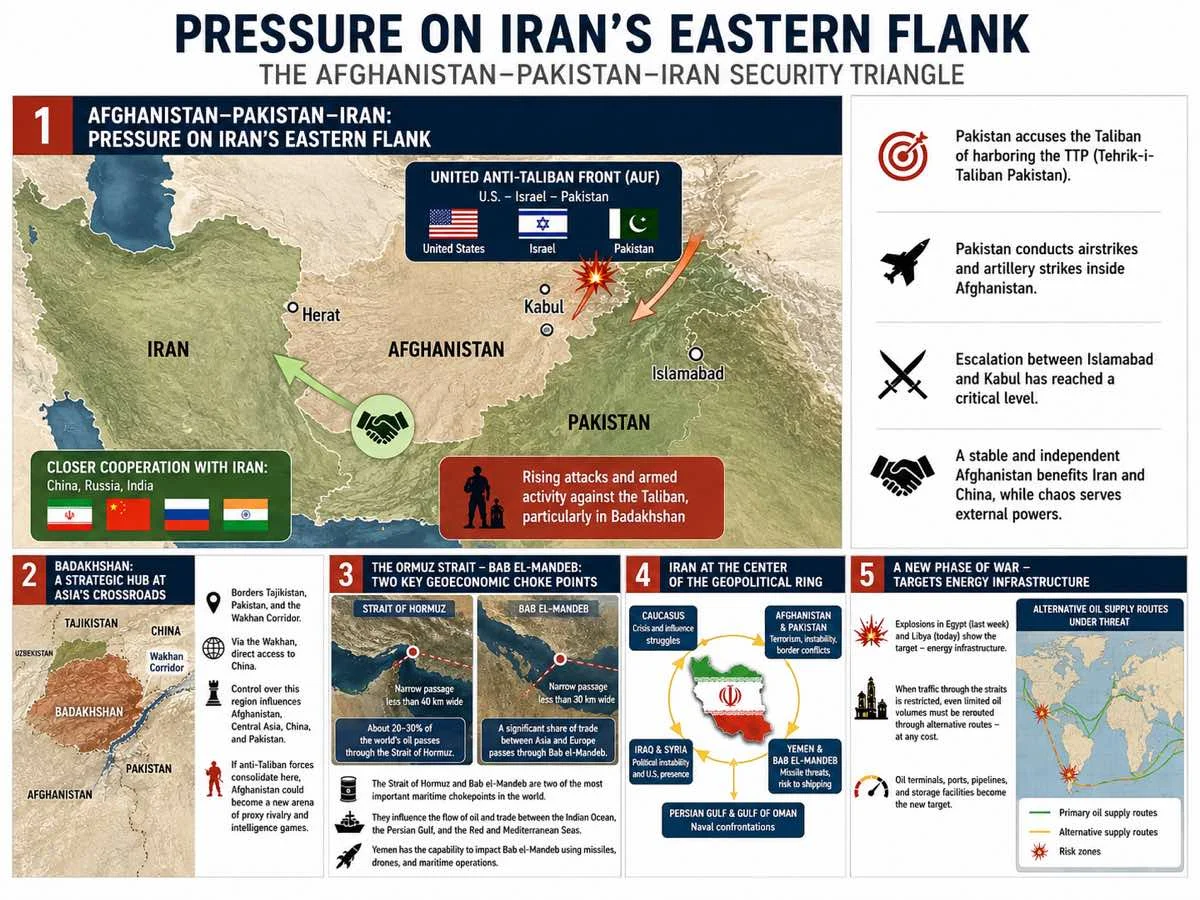
If the Taliban opponents manage to create a permanent base in this region, the Afghan issue will again cease to be only an internal crisis. Afghanistan can again turn into a territory of intelligence, power and proxy competition of various players.
At the same time, the split between Pakistan and the Taliban has reached a level that can no longer be considered a normal dispute between the two neighbors.
Islamabad accuses the Afghan Taliban of allowing the Tehrik-e-Taliban Pakistan — TTP — to use Afghan territory against Pakistan.
The Taliban denies this, but the practical outcome of the conflict is clear: Pakistan is stepping up air, artillery and other military strikes inside Afghanistan, and the Taliban are responding in some cases.
Context and logic of what is happening
This is a hard turn for Pakistan. For decades, much of his Afghan policy was based on the assumption that a Taliban-aligned government in Kabul would limit India's influence and expand Pakistan's strategic depth.
However, today the same Taliban is pursuing an increasingly independent foreign policy and is not ready to fully subordinate the security interests of Afghanistan to the requirements of Islamabad.
This is where Iran comes into the equation.
The gradual rapprochement of the Taliban with Tehran cannot be considered a secondary process. There are still serious disagreements between Iran and the Taliban over Helmand water, migrants, borders and security.
But at the geopolitical level, both sides have come to understand that stability on Iran's eastern border and preventing Afghanistan from becoming a base for anti-Iranian forces create a common interest.
For Iran, a stable Afghanistan, independent of external intelligence and power networks, is much preferable to Afghanistan, once again plunged into internal war, proxy groups and special services competition. It is against this background that Pakistan's pressure on the Taliban is increasing, and the anti-Taliban armed forces are once again intensifying. And here it is no longer possible to consider events in isolation from each other.
That a single command center in Washington or Tel Aviv supposedly manages all these processes by the minute is no longer the main issue. Understanding the strategic interconnection of these fronts does not even require such a hypothesis.
I have been warning for many years that these events are interconnected from a geopolitical point of view. In the east of Iran, Afghanistan is entering a new phase of instability, Pakistan is increasingly in direct conflict with the Taliban, and the armed opposition is re-emerging.
Iran's Resilience and Strategic Choice
In southern Iran, Yemen and the Red Sea are once again becoming the scene of missile, drone and maritime confrontation. Reports of strikes on Mokha should also be considered in this context.
Mokha is more than just a Yemeni coastal town. This area is located along the west coast of Yemen next to one of the world's most important maritime hubs — Bab el-Mandeb.
Bab el-Mandeb, together with the Strait of Hormuz, forms two key geopolitical “neck” around Iran and the Arabian Peninsula. Whoever is able to influence the security of these two straits actually affects part of the energy and trade flows between the Indian Ocean, the Persian Gulf, the Red Sea and the Mediterranean Sea.
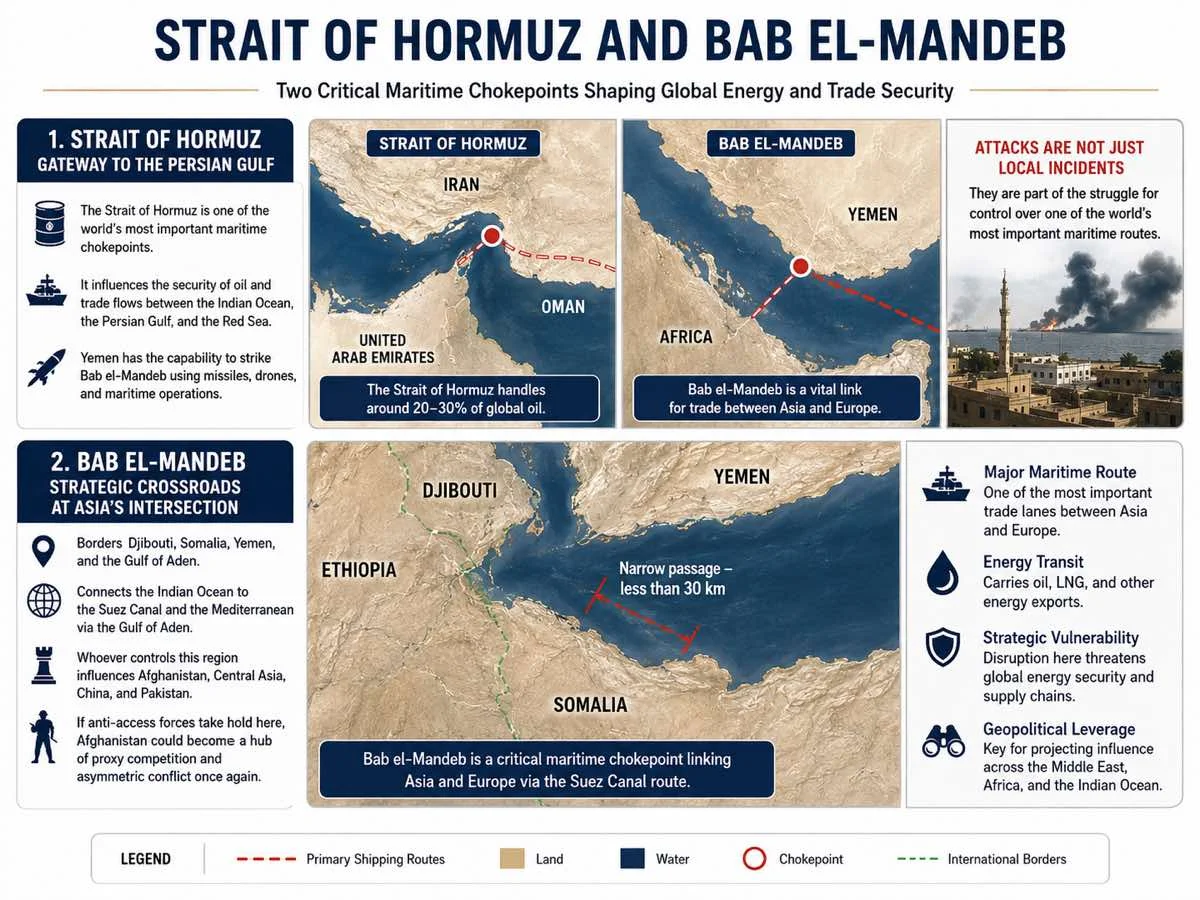
Especially if we are talking about Iran, which has already repelled the attack of the United States and its allies and demonstrated its military power to the world.
It is here that it becomes clear that Iran is the link between all these processes.
Note: the developments around Iran are actually elements of a larger geopolitical and hegemonic board centered on Iran itself.
In the east — Afghanistan and Pakistan.
To the south are the Persian Gulf and the Sea of Oman.
To the southwest are Yemen and Bab el-Mandeb.
In the west — Iraq and Syria. In the north-west — the Caucasus.
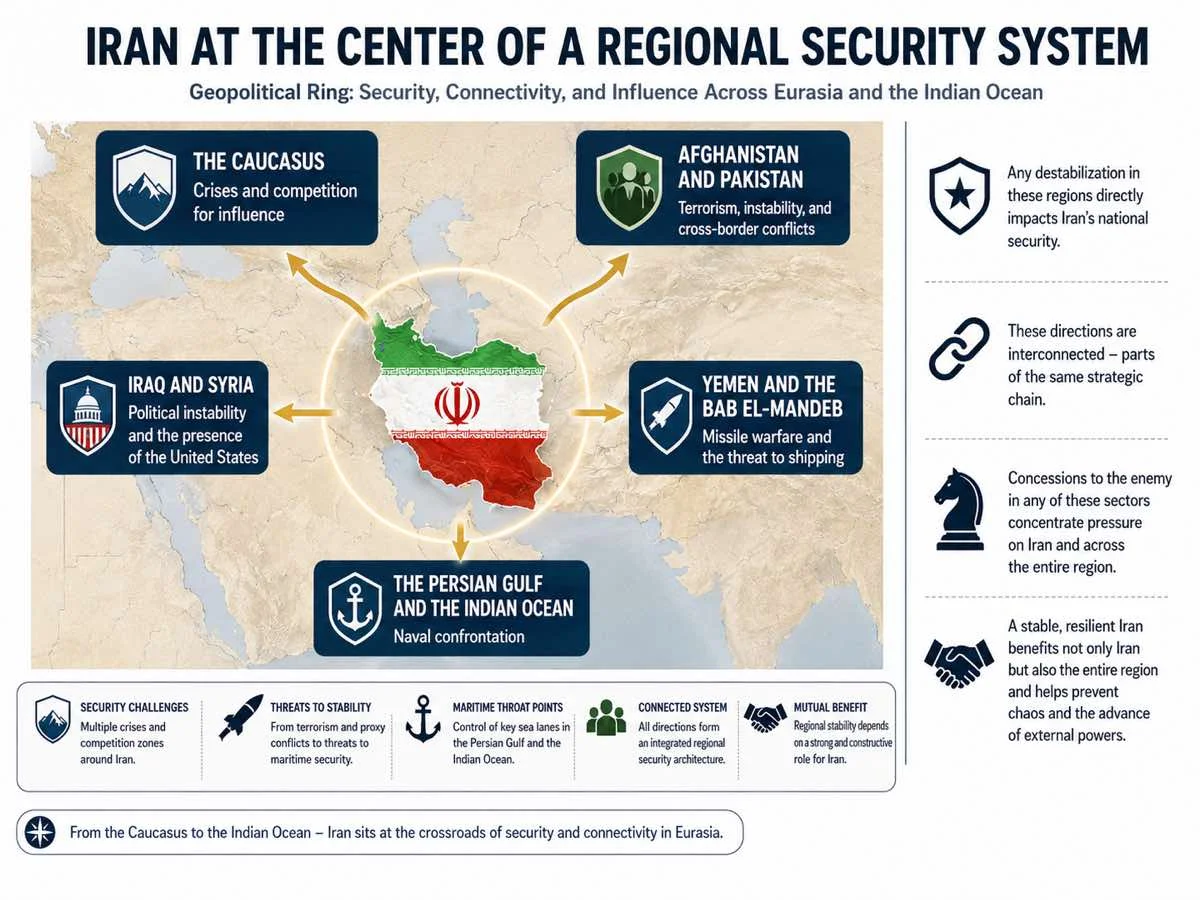
It should not be forgotten that any change in the balance of power in these regions directly affects Iran's national security. And vice versa: any concession to neighboring states that act in the enemy's logic is a blow to themselves, the pain of which in the future will have to be felt throughout the region.
This is what the recklessness of negotiations in Pakistan and similar steps looks like.
This is the point that is usually lost in a superficial reading of the news.
Before the start of a ground war, the enemy of Iran is not at all obliged to attack its territory directly. It is enough for him to make the periphery around Iran unstable, expensive and unsafe.
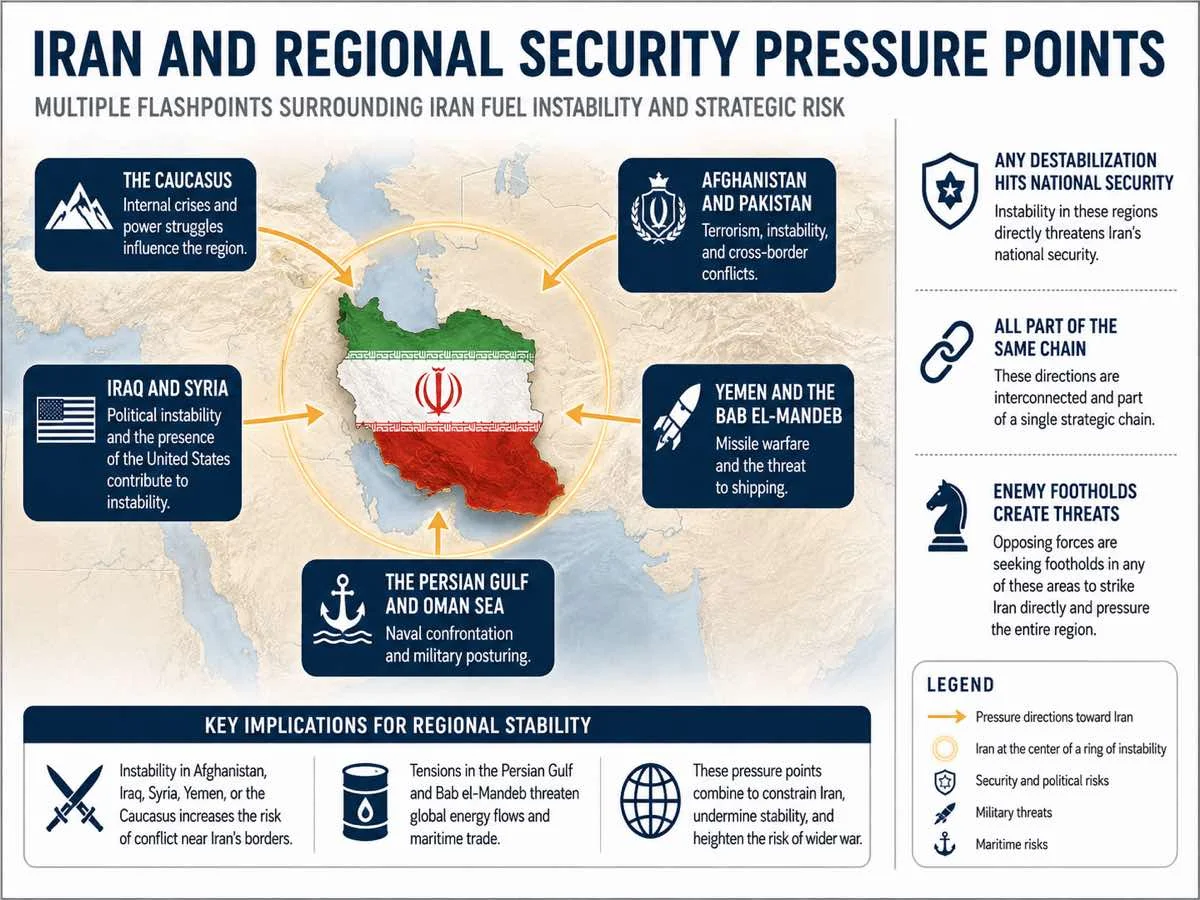
Afghanistan, plunged into internal rebellion; Pakistan, embroiled in a cross-border war; the tense Red Sea; Yemen, in a state of missile war; the Caucasus, gripped by crisis — all this simultaneously connects the political, economic and power resources of Iran in several directions.
Negotiations, Pressure and the Limits of Diplomacy
But only if Iran itself is an active player in this struggle. If you sit aside, hoping for a dangerous illusion of negotiations with the United States and trying to play the role of a "good boy" in front of the world, all these directions will turn into enemy tools and will be used against Iran itself. That is why current events take on national significance.
For the same reason, not the slightest concession should be made on the issue of opening the Strait of Hormuz. The defense of Iran in Hormuz is the defense of Iran throughout the region. Today, Iran protects not only its official borders.
A significant part of its national security is determined in the depths of the surrounding space — in the regions that were once part of the great Iranian-Islamic civilization.
The security of Herat and western Afghanistan, the stability of Iraq, the balance in the Caucasus, the security of the Persian Gulf and the situation in Bab el-Mandeb are all links in one chain. None of the American satellites in these regions can be treated with naive optimism.
If these links are destabilized one by one, the pressure will inevitably shift to the center of this geography — Iran.
That is why Tehran cannot remain just an observer of the events in Afghanistan.
Afghanistan, plunged into chaos or proxy war, does not benefit either Iran, or China, or even Pakistan in the long term — and especially the Afghan people themselves.
Moreover, the secondary consequences, primarily migration, will again fall on Iran.
Such a scenario will only lead to one thing: the return of intelligence networks, armed fraternal Wahhabi-jihadist groups and external operators to one of the most sensitive eastern borders of Iran. Therefore, the issue is much broader than the satisfaction or dissatisfaction of neighboring countries.
The main question is: who will create and then manage the security system around Iran? Iran itself or forces thousands of kilometers away from the region?
The European Factor and the Strategy of the West
From the point of view of Iran's national interests, the answer is obvious: the Islamic Republic of Iran, regardless of ideological or political differences with its neighbors, must prevent the transformation of the country's surrounding belt into a permanent field of proxy wars, and after the expulsion of the United States, form its own regional order.
Even if you look at the situation through the eyes of Westernized liberals, the question has long been not reduced to supporting Yemen, Iraq, Lebanon, the Taliban, Kashmir or anyone else. The speech is about the survival of Iran itself.
Iran is a state that has been at the center of this geopolitical crossroads for thousands of years. And each time, external forces tried to create crisis belts around it in order to raise the price of its independence.
Therefore, events in the region should be perceived not as a set of disparate crises, but as part of a single field of struggle for the future of the regional order.
The future of the children of Iran and other peoples living in the space of the great Iranian civilization depends on how Iran will act today and how steadfast it will be able to hold its positions.